Droopy & Sagging Eyelid Surgery – Ptosis Correction in Singapore

WHAT IS PTOSIS?

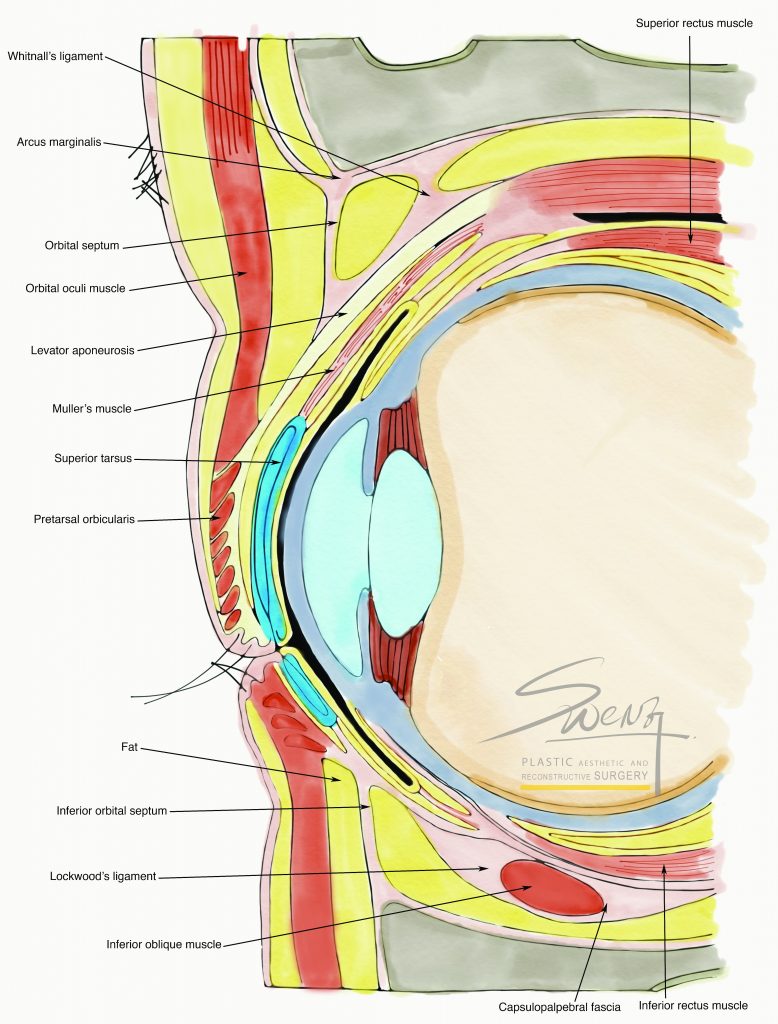
Eye Cross Section - Droopy Eyelid - Blepharoplasty - Ptosis Correction Eye Cross Section – Double Eyelid – Blepharoplasty – Ptosis
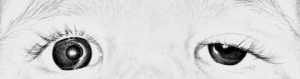
  • Ptosis (blepharoptosis) is the abnormally low (droopy) position of the upper eyelid margin due to a weakness in the lifting mechanism. This mechanism consists of muscle (levator palpebral superioris) and its soft tissue extension (levator aponeurosis)
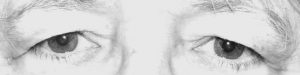
  • It must be differentiated from dermatochalasis. In this condition, excessively lax upper eyelid skin causes a droopy appearance rather than the true weakness of the lifting mechanism of the eye.
  • Blepharoptosis can also co-exist with dermatochalasis.
  • Patients with blepharoptosis or dermatochalasis has tired looking eyes even though they have adequate rest. They usually use their forehead muscles to assist in lifting up the upper eyelids resulting in persistent frownlines. Thus, seeking droopy eyelid treatment is vital.

Ptosis Vs Dermatochalasis

 BlepharoptosisDermatochalasis
Diagram
Blepharoptosis - Droopy Eyelid - Ptosis Correction Blepharoptosis
Dermatochalasis - Droopy Eyelid - Differentiate from Ptosis Correction Dermatochalasis
MechanismDroopy lid due to weakness in the lifting mechanism of eyelid.Droopy lid due to excessive eyelid skin.
What covers the limbus?Ciliary margin (eyelash margin)Skin edge of redundant upper eyelid skin
Age groupAll ageOlder age
Associated disorderBoth conditions can co-exist
Medical claimsConsidered medical conditionConsidered cosmetic condition

*Limbus – Junction between the cornea and the sclera (the black and the white of the eye)


ASSESSMENT OF BLEPHAROPTOSIS

  • Blepharoptosis is assessed based on two parameters :
    • Degree of blepharoptosis – the severity of blepharoptosis
    • Levator function – the residual lifting ability of the upper eyelid opening mechanism


DEGREE OF BLEPHAROPTOSIS

There are two methods to measure the severity of blepharoptosis

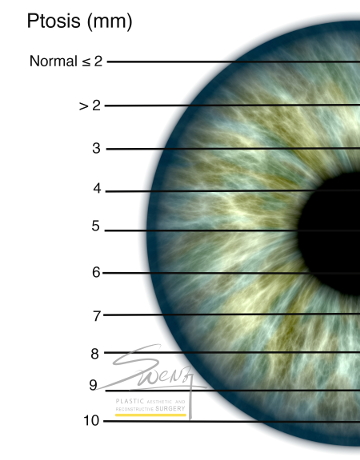
1. Amount of upper lid droop or descent (over the limbus)
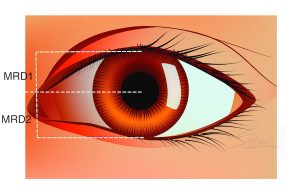
Blepharoptosis Assessment - MRD measurement for droopy eyelid Blepharoptosis Assessment – MRD

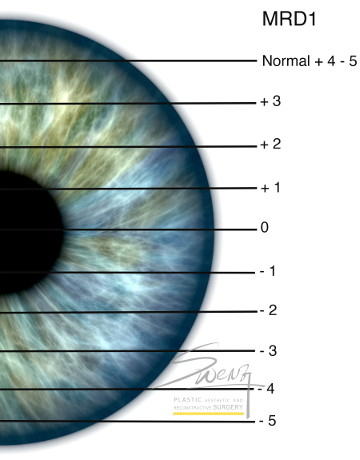
2. Marginal Reflex Distance

    • Most accurate method to measure degree of blepharoptosis
    • It is a vertical distance between the pupillary light reflex and the eyelid margin.
    • Types of MRD :
      • MRD1
        • Distance from the pupil center to the upper eyelid
        • Blepharoptosis present if MRD1 < 4 mm
      • MRD2
        • Distance from the pupil center to the lower eyelid
        • Lower lid retraction if MRD2 > 6 mm
 Lid Descent over Upper LimbusMRD1
Degree of Blepharoptosis
Ptosis Assessment by Coverage of Limbus - Droopy eyelid Ptosis Assessment by Coverage of Limbus
Blepharoptosis Assessment by MRD for droopy eyelid Blepharoptosis Assessment by MRD
Mild1-2 mm3-4 mm
Moderate3 mm2 mm
Severe> 4 mm1 mm


LEVATOR FUNCTION

  • The levator palpebral superioris is the main muscle responsible for eye opening.
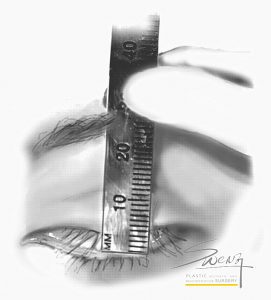
  • To measure the residual lifting ability of the upper eyelid opening mechanism, the patient is asked to look downwards and then upwards while immobilizing the brow. The amount of eyelid movement is called levator excursion and this reflects levator function.
  • The levator function and degree of blepharoptosis determine the type of corrective surgery to be done.


Table of Levator Function Assessment

Levator ExcursionLevator Function
Levator Function Test for Droopy Eyelid - Lid Closed Levator Function Test – Lid Closed
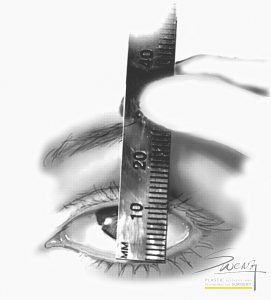
Levator Function Test for Droopy Eyelid - Lid Open Levator Function Test – Lid Open
Good : >10 mm
Fair : 5-10 mm
Poor : 0-5 mm


SUITABLE CANDIDATES FOR PTOSIS CORRECTION SURGERY

  • Patient with established blepharoptosis.
  • Patient with blepharoptosis concomitant dermatochalasis. 


DESCRIPTION OF PTOSIS CORRECTION PROCEDURE

Table of Status of Levator Function and Corresponding Ptosis Correction Procedures

 Levator Function
 Excellent (> 10 mm)Moderate (5-10 mm)Poor (0-5 mm)
Type of Procedure
  • Aponeurotic surgery (Fasanella-Servat procedure, Putterman’s procedure, Mutarde’s Split Level Approach)
  • Mullerectomy
  • Levator advancement or plication
  • External levator resection
  • Frontalis suspension
  • Frontalis Orbicularis Oculi Muscle (FOOM) flap
  • Many surgical procedures have been described for the correction of blepharoptosis tailored according to levator function.
  • Common procedures performed by our surgeon is sagging eyelid correction – levator plication and levator advancement.
  • The levator aponeurosis is shortened by pleating and suturing in levator plication procedure. A portion of the excess aponeurosis is removed and the free edges are overlapped and sutured together in the levator advancement procedure.
  • The incisions and scar for blepharoptosis correction are similar to conventional blepharoplasty. The scar is hidden in the eyelid crease.
  • However, the scope of surgery is vastly different. It is a very delicate surgery that require meticulous dissection of the opening mechanism of the eye and it takes longer duration than conventional blepharoplasty.
  • During the operation patient may be required to sit up and check for symmetry of eye opening several times after correction.
  • Ptosis correction ( droopy eyelid surgery )  can be combined with conventional upper blepharoplasty procedure for :
  • Surgical duration: 2-4 hours
  • Day Surgery (home on the same day)


ANAESTHESIA

  • Combination of local anaesthesia with light intravenous sedation administration:
    • Maximal patient comfort
    • Patient able to participate in checking symmetry of eye-opening during the surgery.
  • General anaesthesia:
    • At the special request of the patient.
    • Result might be affected because of the inability to check for symmetrical eye-opening.


POST OPERATIVE CARE

  • Mild discomfort to be expected includes:
    • Swelling usually resolves in 1 week.
      • In rare instances swelling may take several weeks to resolve.
      • Avoid exertion and rest 30 degree head up to hasten resolution of swelling.
    • Bruising usually resolves in 2 weeks.
    • Tearing
    • Lagophthalmos
      • Incomplete eyelid closure – usually transient
      • May need lubricant eye drop or eye gel to prevent corneal desiccation (drying).
      • Eye pad may be required during sleep.
    • Post-operative medication:
      • Antibiotic ointment to be applied regularly 3-5 times a day
      • Antibiotic eye drop 3 times a day
      • Oral antibiotics
      • Analgesics (pain relief) and anti-swelling medications
    • Removal of suture at 1 week.
    • Resumption of light exercise for 3-4 weeks.
    • Refrain from wearing contact lenses up to 4 weeks post-surgery.


RISK AND COMPLICATION OF DROOPY EYELID CORRECTION TREATMENT

  • Bleeding/ Haematoma (blood clot accumulation)
    • Avoid exertion post-operative.
  • Infection
    • Very rare
    • Avoided by clean (sterile) technique during the surgery.
  • Asymmetrical eye-opening is fairly common in the early post-operative period


FREQUENTLY ASKED QUESTION

Is asymmetrical eye-opening common after blepharoptosis correction?

  • This is a common occurrence and it is usually transient. The eye will take a short while to adjust to its new eyelid opening position.
  • Many patients have pre-existing asymmetrical height of the globe of the eye, the size of eye-opening, the amount of extra skin and fat in the eyelids, and the distance between the brow and upper lid.
  • Due to all these factors, asymmetry can still result despite best efforts during surgery.


Is it common to perform ptosis surgery (sagging eyelid correction surgery) in only one eye?

  • Although blepharoptosis may be unilateral (exist in one eye) it is common to suggest a correction in both eyes because ptosis correction in one eye can affect the eye-opening of the opposite (unoperated) eye. During the consultation, Dr Ng would explain why this is affected by the complex nature of equal innervation of both eyes (Hering’s law).

COST OF DROOPY EYELID SURGERY

  • Blepharoptosis correction is considered medical and financial assistance by medical insurance is possible provided a set of strict criteria are met. These criteria include special test e.g. visual field testing by an eye specialist.
  • The amount of reimbursement by the insurance company is determined on a case-by-case basis by their assessment team.


During your consultation, our plastic surgeon will explain the most common causes of ptosis, sagging or droopy eyelids, and recommend the most suitable droopy eyelid correction surgery and treatment methods for you.
Double Eyelid Surgery – Incisional Blepharoplasty

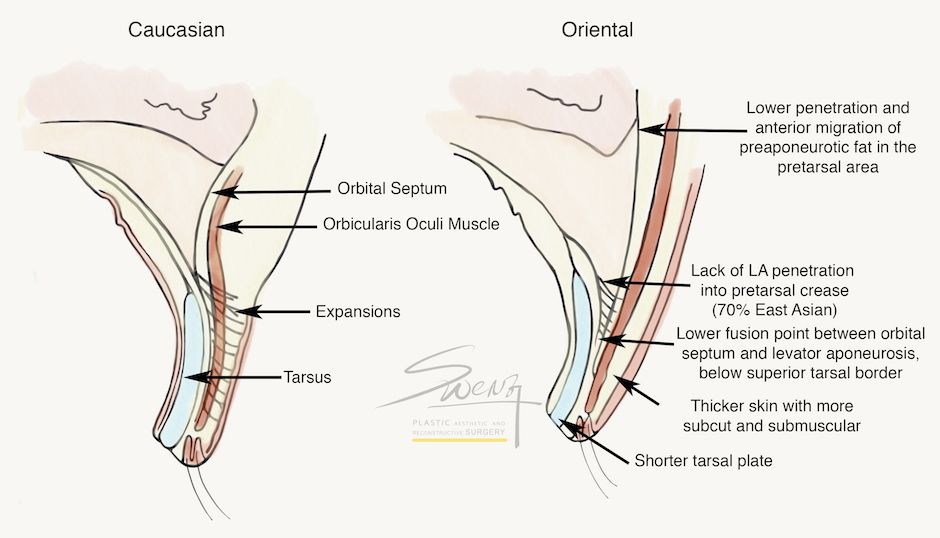
ASIAN VS CAUCASIAN EYELIDS

Caucasian Double Eyelid vs Oriental Single Eyelid - Double Eyelid Surgery Caucasian Double Eyelid vs Oriental Single Eyelid
  • The levator aponeurosis is part of the opening mechanism of the eye and which is closely related to the tarsal plate. It sends multiple slips of dermal (skin) extension which pulls on the pretarsal upper eyelids skin creating the double eyelid fold (palpebral fold).
  • In many Oriental patients, the levator aponeurosis expansions (penetration) into the pre-tarsal crease are absent. This results in single eyelid appearance.

INTRODUCTION

  • Upper eyelid surgery (blepharoplasty) can create or improve the configuration of double eyelid or remove excessive droopy skin. It can be done by incisional method or by suture technique.
  • There are 2 methods of upper eyelid surgery:
  • Purpose of incisional blepharoplasty :
    • Creation of double fold :
      • During incisional blepharoplasty, excess skin is removed and very fine sutures secured the wound edge (which is the location of the double fold) to the deeper eyelid structures to create a permanent fold.
    • Removal of excessive upper eyelid skin (which causes the eye to appear “aged” and may obstruct vision)
    • Removal of excessive upper eyelid fat pad (which gives the eyelid a puffy appearance), eyebag surgery is often done concurrently.
    • Correction of ptosis (Droopy eyelid)

COMPARISON OF SUTURE AND INCISIONAL BLEPHAROPLASTY

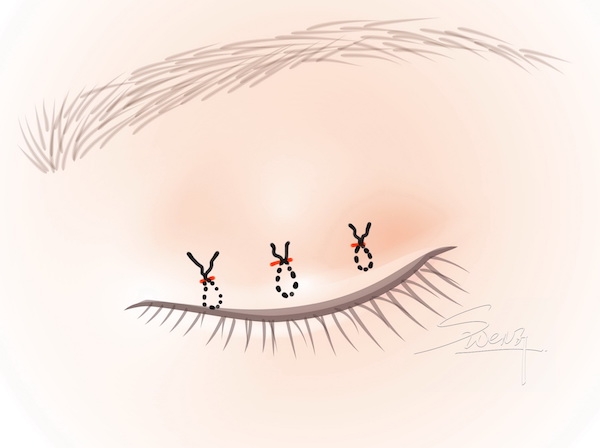
Suture Double Eyelid Surgery(scarless)Incisional Double Eyelid Surgery
Photo
Suture Blepharoplasty - Scarless Double Eyelid Surgery Suture Blepharoplasty
Suture blepharoplasty - Cross section - Scarless Double Eyelid Surgery Suture blepharoplasty – Cross section
Incisional Blepharoplasty - Double eyelid surgery Incisional Blepharoplasty
Purpose
  • Creation of double eyelid fold in young patient who have no upper eyelid skin excess or fat excess.
  • Creation of double eyelid fold (for all age groups)
  • Removal of excessive upper eyelid skin
  • Removal of excessive upper eyelid fat pad.
  • Ptosis correction
ScarScarlessFaint scar in the upper eyelid crease
Longevity of ResultLess permanent upper eyelid fold (unpredictable loss of fold)Permanent
Post-surgery downtimeGenerally limited swelling and bruising (however some patients has downtime similar to incisional blepharoplasty)Swelling much improved after 1-2 weeks
Suture RemovalUsually none1 week post operative

STYLE OF UPPER LID DOUBLE FOLD (PALPEBRAL FOLD)

TAPERED FOLD (IN FOLD)PARALLEL FOLD (OUT FOLD)
Upper Eyelid - High Tapered fold - Blepharoplasty - Double eyelid surgery Upper Eyelid – High Tapered fold – Blepharoplasty
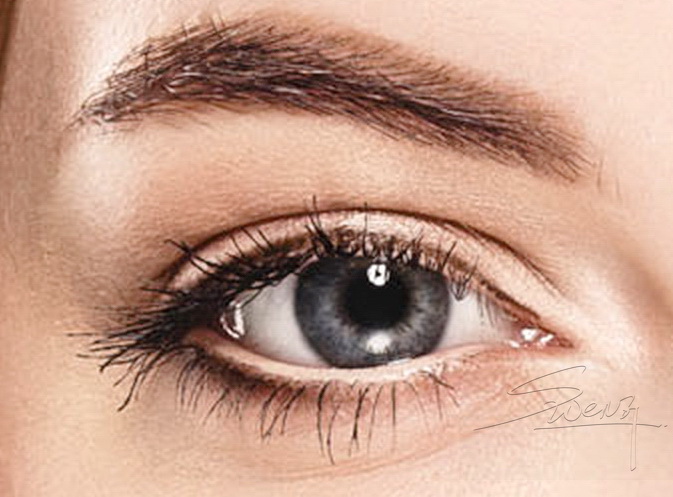
Upper eyelid - Parallel fold - Blepharoplasty - Double eyelid surgery Upper eyelid – Parallel fold – Blepharoplasty
  • More common among Orientals.
  • Inner corner of the double fold starts of nearer the eyelash margin and gradually tapers outwards.
  • More common among Caucasians.
  • Entire length of double fold is almost parallel to the eyelash margin.
LOW FOLDHIGH FOLD
Upper eyelid - Low in-fold - Blepharoplasty - Double eyelid surgery Upper eyelid – Low in-fold – Blepharoplasty
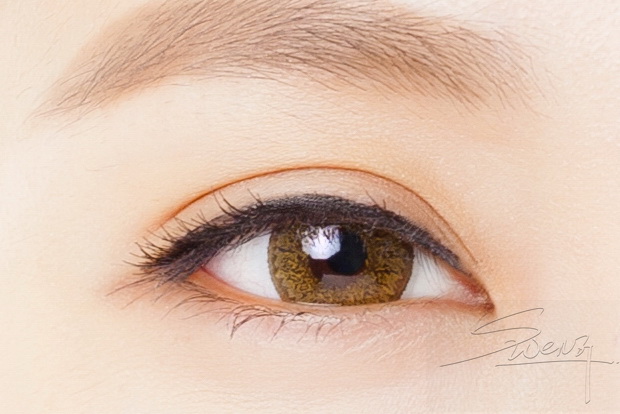
Eyelid - Tapered fold (high) - Double eyelid surgery Eyelid – Tapered fold (high)
  • Narrow separation of double fold.
  • Appears more natural.
  • Double fold tends to disappear earlier with ageing.
  • Wide separation of double fold.
  • Appears less natural.
  • Results last longer and becomes more natural with ageing
  • The style of double eyelid fold is summarized in the table above.
  • Some patients have strong tendency towards forming parallel fold. It may not be easy to create a tapered fold in this group of patients.
  • During consultation Dr. Ng will advise you regarding the most suitable style and height of double eyelid fold to be created.
  • In some instance the original height of the double eyelid crease can be maintained.

SUITABLE CANDIDATES

  • Patient of any age group who wishes to create double upper eyelid fold.
  • Patient with excessive upper eyelid causing aged appearance and/or obstructing vision
  • Patient with puffy eyelids due to fat pad excess
  • Patient who has weakness in the opening mechanism of the eye (Ptosis)

DESCRIPTION OF PROCEDURE

  • Marking and taping simulation of the intended fold height before surgery in agreement with patient
  • Incision over intended eyelid fold
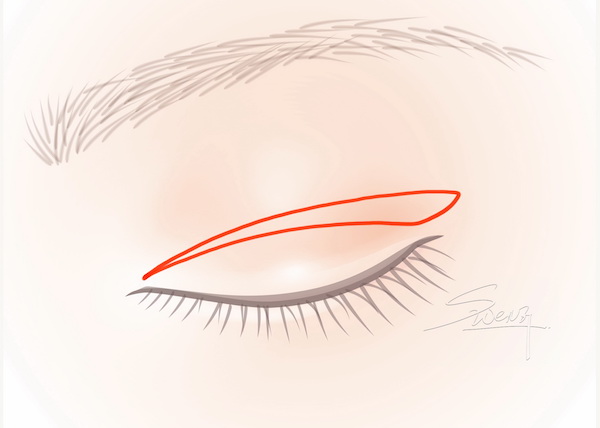
  • Removal of excessive upper eyelid skin, muscle and fat pads if present
  • Upper eyelid crease is secured by tagging the intended fold to the deeper structures including tarsal plate.
  • Meticulous wound closure with very fine non-absorbable sutures.
  • Topical antibiotic ointment
  • Surgical duration : about 1.5 hours
  • Home on the same day

ANAESTHESIA

  • Combination of local anaesthesia with IV sedation administration – for greatest comfort

POST OPERATIVE CARE

  • Mild discomfort to be expected includes:
    • Swelling usually resolves by 1 week.
      • In rare instances swelling may take several weeks to resolve.
      • Avoid exertion and rest 30 degree head up to hasten resolution of swelling.
    • Bruising usually resolves by 2 weeks.
    • Tearing
  • Post-operative medications:
    • Antibiotic ointment to be applied regularly 3-5 times a day
    • Antibiotic eyedrop 3 times day
    • Oral antibiotics
    • Analgesics (pain relief) and anti-swelling medications
  • Removal of suture at 1 week.
  • Resumption of light exercise for 3-4 weeks.
  • Refrain from wearing contact lens up to 4 weeks post-surgery.

RISK AND COMPLICATION

  • Bleeding/ Haematoma (blood clot accumulation)
    • Avoid exertion post-operative.
  • Infection
    • Very rare
    • Avoided by clean (sterile) technique during the surgery.

FREQUENTLY ASKED QUESTION

Can we ensure symmetrical result after blepharoplasty ?

  • Perfectly symmetrical eyes are uncommon.
  • Many patients have pre-existing asymmetrical height of the globe of eye, size of eye-opening, the amount of extra skin and fat in the eyelids, and the distance between the brow and upper eyelid.
  • Because of all these factors, asymmetry can still result despite best efforts to plan the fold symmetrically.
  • Incisional blepharoplasty is more suitable to improve symmetry if you have obviously asymmetrical upper eyelids.

Can double eyelid surgery give me brighter and more alert looking eyes ?

  • This depends on whether the patient has pre-existing droopy upper eyelids (blepharoptosis)
  • The “bright, alert and non-sleepy” appearance of the eyes is determined by how wide the upper eyelid can open (imagine this as the “window opening”). This opening is controlled by the lifting mechanism of the upper eyelid which is in the deepest layer of the upper lids. In the usual double eyelid surgery, we operate on the superficial layers and not the deeper layer (imagine this as “trimming the curtain” only). Therefore, if the patient has pre-existing droopy upper eyelids (blepharoptosis), simple double eyelid surgery cannot restore the bright and alert appearance.
  • If the patient has no pre-exiting blepharoptosis but only significant skin excess, creation or restoration of double eye fold together with removal of skin excess can potentially brighten up the eyes.
  • This is the reason occasionally double eyelid consultation become prolonged due to additional explanation needed in some cases.

A consultation would guide you regarding which is the most common and best procedure used by top Singapore plastic surgeon for double eyelid surgery.

Eye Bag Removal Surgery In Singapore – Lower Blepharoplasty

What Causes Eye Bags?

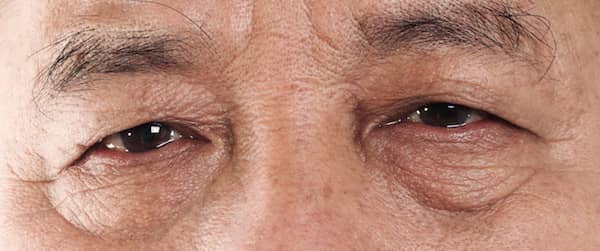
Eye bags are caused by excessive fat accumulation and also laxity of skin and orbital septum which contains the bag of fat.

Eyebag

Eye Bag Removal & Treatment Methods in Singapore

Lower blepharoplasty, otherwise known as eye bag removal in Singapore, can address both eye bag and lower lid skin excess and laxity.

There are 2 main eye bag removal surgery methods:

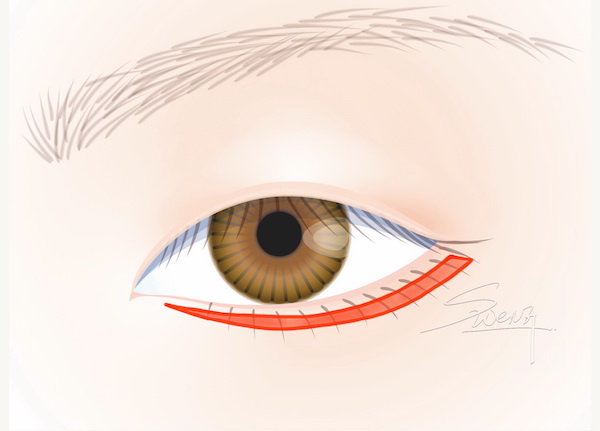
1. Subciliary Lower Blepharoplasty (External Method)

  • This method is suitable for patients with excess lower eyelid skin and fat pockets. Removal of fat alone would result in gathering of excessive loose skin.
  • A fine cut is made just below the lower lid eyelashes. A small strip of excess skin and fat is then removed.
  • Those patient with severe laxity of the lower lid may need additional tightening procedure to prevent drooping of the lower eyelid post surgery (lateral canthopexy or lateral canthoplasty).
  • The scar below the eyelashes often becomes imperceptible after about 3 months.

2. Transconjunctival Lower Blepharoplasty (Scarless Method)

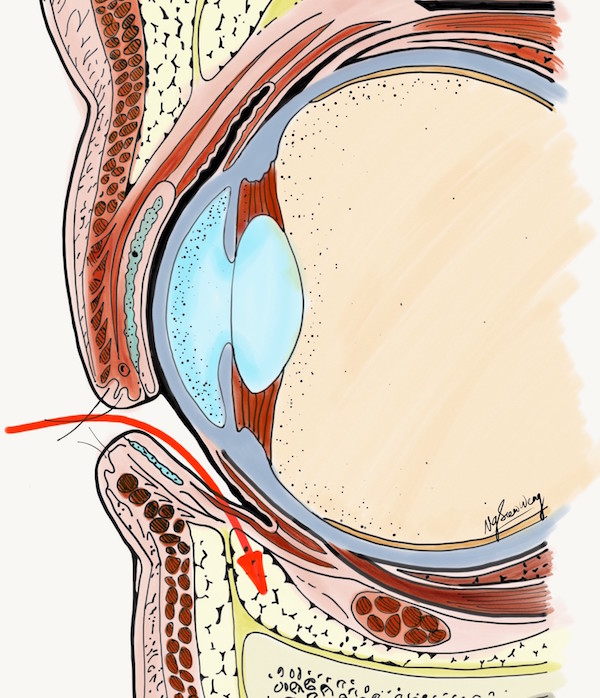
  • This method is suitable for young patients with no skin laxity/excess. The fat pocket is removed via a small cut in the back of the lower lid, leaving no scar on the exterior.


COMPARISON OF SUBCILIARY VS TRANSCONJUCTIVAL LOWER BLEPHAROPLASTY

Subciliary Lower Blepharoplasty (External Method)Transconjunctival Lower Blepharoplasty (Scarless)
Photo
Lower Blepharoplasty - Eyebag RemovalLower Blepharoplasty – Eyebag Removal
Lower blepharoplasty - Transconjunctival - Scarless Eyebag Removal Lower blepharoplasty – Transconjunctival – Scarless Eyebag Removal

Side profile of the lower lid showing the cut on the inner (conjunctival) surface.

ScarFaint scar – below eyelashScarless (incision hidden on the inner surface of the lower eyelid)
What is done
  • Removal of eyebag
  • Removal of lower lid skin excess.
  • Lateral canthopexy to tighten lower lid laxity (optional)
  • Fat redistribution to smoothen the contour of the lower eyelid (optional)
  • Laser resurfacing of wrinkled lower lid skin (optional)
  • Removal of eyebag
  • Fat injection to smoothen the contour of the lower eyelid (optional)
  • Laser resurfacing of wrinkled lower lid skin (optional)
Suitable patientAll patients with eyebag.Younger patient with eyebag, and no lower lid skin excess or laxity.
Suture Removal1 weekNone


PROCEDURES DONE TOGETHER WITH EYE BAG REMOVAL SURGERY:

The following procedures are commonly combined with eye bag removal surgery:


METHODS OF EVALUATION FOR LOWER LID SKIN LAXITY

  • It is common to remove excess lower lid skin after the removal of the eyebags. If there is a pre-existing laxity of the lower lid, removal of skin excess can cause the lower lid to droop and turn outwards away from the eyeball (ectropion).
  • There are two ways to assess lower lid laxity :
    • Pinch test (snap-back)
      • The lower lid skin is pulled downwards forwards and allowed to snap backwards. This checks the laxity of the lower lid (tarsal laxity).
    • Distraction Test
      • Pull the lower lid skin away from the white of the eye (sclera). A gap of more than 8 mm denotes laxity (tarsoligamentous).

Lateral Canthopexy

  • It is a procedure done to tighten the lower lid to prevent ectropion. A non-absorbable suture is placed over the lateral corner of the lower lid (lateral canthus) and tied to the sidewall of the bony socket of the eye (lateral orbital rim).


DESCRIPTION OF EYE BAG REMOVAL PROCEDURE

Transconjunctival lower blepharoplasty (scarless method)

  • The lower lid is pulled downwards and a small cut is made on the inner (conjunctival surface).
  • Resection of the excess medial, central and lateral fat pad.
  • Wound closure with absorbable sutures.
  • Adjunctive procedure :
    • Fat transfer to lower lids
    • Laser skin resurfacing treatment to lower eyelid/ face
  • Surgical duration: 1 hour
  • Day Surgery (home on the same day)

Subciliary Lower Blepharoplasty

  • Pre-operative marking to determine the amount of lower lid skin to be removed.
  • A cut is made just below the eyelash margin.
  • Dissection to expose and remove the excess lower lid fat pads (eye bags).
  • Excess lower lid skin is trimmed.
  • Wound closure with very fine non-absorbable suture.
  • Adjunctive procedure :
    • Lateral canthopexy to tighten the lower lid and prevent ectropion.
    • Fat transfer to lower lids
    • Laser treatment to lower eyelid/ face
  • Surgical duration: 1-2 hours
  • Day Surgery (home on the same day)


ANAESTHESIA

  • A combination of local anaesthesia with IV sedation for maximal patient comfort.


POST OPERATIVE CARE

  • Mild discomfort to be expected includes:
    • Swelling usually resolved in 1 week.
      • In rare instances, swelling may take several weeks to resolve.
      • Avoid exertion and raise the head up by 30 degrees to hasten the resolution of swelling.
    • Bruising is usually resolved in 2 weeks.
    • Tearing
  • Post-operative medications:
    • Antibiotic ointment to be applied regularly 3-5 times a day
    • Antibiotic eye drops 3 times a day
    • Oral antibiotics
    • Analgesics (pain relief) and anti-swelling medications
  • Removal of suture at 1 week.
  • Resumption of light exercise after 3-4 weeks.
  • Refrain from wearing contact lenses up to 4 weeks post-surgery.


RISK AND COMPLICATION OF EYE BAG REMOVAL SURGERY

  • Bleeding/ Haematoma (blood clot accumulation)
    • Avoid exertion post-operative.
  • Infection
    • Very rare
    • Avoided by clean (sterile) technique during the surgery.
  • Ectropion/ Scleral show
    • This is prevented by performing lateral canthopexy.


COST OF EYE BAG REMOVAL SURGERY

  • Lower blepharoplasty for the removal of eye bags is considered as cosmetic surgery. The correction of ectropion is a medical procedure.


During your consultation, Dr Ng will discuss popular eye bag removal surgery methods in both Singapore and Korea. Our plastic surgeon will tailor the eye bag removal methods to best suit your needs.

Upper Eyelid Surgery – Upper Blepharoplasty

Upper eyelid surgery (blepharoplasty) can be done to create or improve the configuration of double eyelid or remove excessive droopy skin.

It can be done by incisional method (that result in a faint scar) or by suture technique (which does not leave a scar).

There are 2 methods of upper blepharoplasty (eyelid surgery):

  • Incisional blepharoplasty
  • Suture blepharoplasty (scarless)

Incisional Blepharoplasty

Incisional blepharoplasty can create a permanent upper eyelid fold.
It can also remove excessive upper eyelid skin and fat pads at the same time.
Therefore it is suitable for young patients who wish to create upper lid fold or older patient with droopy and puffy eyelids.

Suture Blepharoplasty

Suture blepharoplasty is used to create upper eyelid fold. The result is less permanent than incisional blepharoplasty. The recovery time is short. But excessive upper eyelid skin and fat pads cannot be removed by this method.

Upper blepharoplasty is done under local anaesthesia with sedation for greater comfort.
Most of the swelling and bruising would subside after two weeks. The scar usually becomes imperceptible after a few months.

Ptosis Correction

Ptosis (drooping) of the upper eyelid can co-exist with excessive skin. Not all patient with skin excess has ptosis.
The various methods of ptosis correction depending on severity include : Levator plication or advancement, and in more severe cases the FOOM flap.
The surgical incision is similar to upper blepharoplasty. Excess skin is removed at the same time to achieve symmetry.

The Ministry of Health issues very strict guidelines on the use of Medisave for Ptosis correction. Verification with an opthalmologist is required.